
Better Beer Begins with Better Process Filtration
How breweries can protect flavour, consistency and shelf life—from the brewhouse to packaging
Great beer starts with great ingredients. Keeping it great depends on controlling what enters the process at every stage.
Yeast, hop material and proteins are part of brewing. Unwanted particles, microorganisms, oil, moisture and rust are not. The right filtration strategy helps a brewery protect the beer’s intended flavour and appearance, produce more consistent batches, reduce spoilage risk and keep production moving.

Since 1978, ultrafilter Kronsbein has developed filtration products for sterile air, gases, liquids and steam. In Canada, and across North America, ultrafilter supplies filtration solutions and technical support for breweries of every size.
The objective is not simply clearer beer. It is greater control over the entire brewing process.
Where process filtration matters in a brewery
Every brewery is different, but filtration normally supports four critical process areas:
- Beer and process liquids — removing unwanted solids or microorganisms at the appropriate stage.
- Compressed air and process gases — protecting direct- and indirect-contact applications from particles, oil aerosols, moisture and microorganisms.
- Steam — removing pipe scale and other contaminants from steam used in sanitary applications.
- Water and packaging operations — supporting consistent rinse water, bottle or can preparation, and the hygienic integrity of the finished product.
1. Liquid filtration: clarity without sacrificing character
Liquid filtration may be used to remove yeast, grain particles, hop material, proteins, diatomaceous earth and other suspended solids. The appropriate method depends on the beer style, production volume, required clarity, target shelf life and whether microbial stabilization is required.
Common approaches include:
- Depth filtration, which captures particles throughout the filter media and is commonly used for clarification or as protection for a finer downstream filter.
- Membrane filtration, which retains particles or microorganisms at the membrane surface and can provide a defined level of final filtration.
- Crossflow filtration, which moves beer tangentially across a membrane and can reduce cake build-up in larger or more automated operations.
- Activated carbon filtration, typically applied to process water or targeted impurity removal—not indiscriminately to finished beer, where it could alter flavour and aroma.
There is no universal “best” filter. An element that is too coarse may not deliver the required protection; one that is unnecessarily fine may restrict flow, increase cost or strip characteristics the brewer worked to create.
ultrafilter Canada helps breweries review flow, pressure, temperature, product compatibility, microbial-retention requirements and change-out frequency before recommending a housing and element combination.
2. Sterile air and gas filtration: protect every product-contact point
Compressed air is often treated as a utility, but when it contacts product, packaging or a cleaned surface, its quality becomes part of the process.
Potential brewery applications include:
- wort aeration, where filtered air may be used to provide oxygen before fermentation;
- tank or vessel pressurization and blanketing with appropriately filtered process gas;
- product transfer and packaging equipment;
- air used around fillers, kegs, cans and bottles; and
- sterile venting of tanks and vessels.
Filtration should be selected around the actual risk at each point of use. A complete treatment train may include water separation, coalescing filtration, activated carbon, particulate filtration and a final sterilizing-grade element. The final element does not correct a poorly maintained upstream air system.
For critical applications, performance must be supported by proper installation, validated operating conditions, integrity testing where applicable and documented maintenance procedures.
A filter cartridge is only one part of sterile-air control. The system around it matters just as much.
3. Steam filtration: sanitary steam starts upstream
Steam used for direct product contact, sterilization or sanitary processes must be appropriate for the application. Pipe scale, rust and other debris can travel through an unfiltered distribution system and reach downstream equipment.
A correctly designed steam-filtration assembly can help remove particulates while maintaining the required flow and pressure. Housing material, element grade, condensate management, installation orientation and steam velocity must all be considered.
Where a brewery requires 3A culinary, clean or high-purity steam, the filtration specification should be established from its process, quality and regulatory requirements—not from a label alone.
4. Packaging and wash-water filtration: protect the final metres
Beer is most vulnerable when a finished, stable product is exposed to the packaging environment. Water used for rinsing, bottle or can preparation, cleaning, and other product-adjacent duties should therefore be assessed as carefully as the beer itself.
A staged system may use coarse prefiltration to protect downstream equipment, followed by finer filtration selected for the water quality and application. Carbon may be appropriate where chlorine, odour or selected organic compounds must be reduced, while a final cartridge can provide defined particulate or microbial control.
The exact sequence should be determined by a water analysis and the brewery’s process requirements. More stages do not automatically mean better water; the right stages do.
The five filtration problems brewers ask us to solve

Consistency
The same recipe should not produce a different result because filtration performance drifted from one batch to the next. Correct sizing and documented change-out criteria help make filtration repeatable.
Product integrity
The goal is to remove the unwanted material without removing the flavour, aroma or body that defines the beer. Filter media, retention rating and operating conditions must suit the product.
Throughput
An undersized housing or poorly selected element can create excessive pressure drop and slow production. Reviewing peak flow—not only average flow—helps prevent filtration from becoming the bottleneck.
Cost
The lowest cartridge price is not necessarily the lowest filtration cost. Service life, pressure loss, labour, cleaning or sterilization cycles, product loss and downtime all affect total cost of ownership.
Availability
Even the best-performing filter cannot protect production if the replacement is unavailable. Standardizing elements, forecasting demand and maintaining sensible minimum and maximum inventory levels reduce emergency purchases and line stoppages.
ultraplanning: the right element, ready when you need it
ultraplanning is ultrafilter Canada’s vendor-managed filtration program. It begins with a discovery review of the filtration currently in use, including each housing, point of use and element specification. On-site inventory can then be catalogued to identify duplicate products, inconsistent part numbers and supply risks.
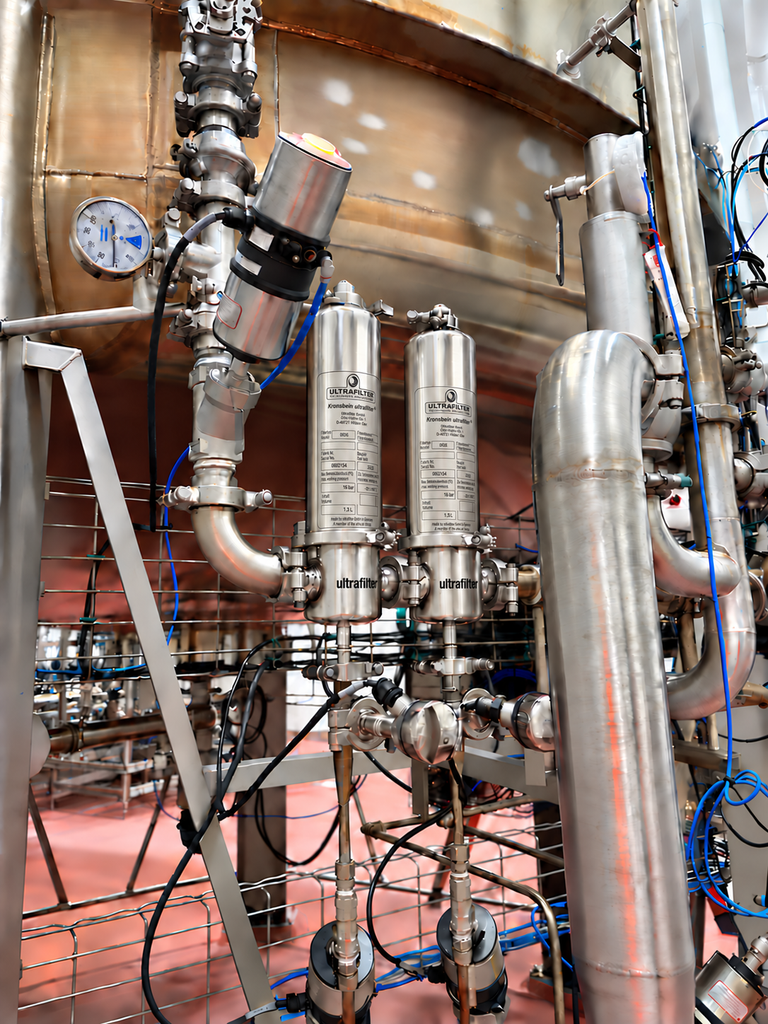
Together, we establish practical stock levels and planned change-out dates. The program can provide:
- a single, documented filtration inventory;
- fixed pricing for an agreed term;
- just-in-time delivery;
- reduced duplicate and excess stock;
- audit-document control; and
- planned element replacement—on time, every time.
The aim is simple: fewer surprises and no filtration-related stockouts.
A better filtration review begins with better questions
Before selecting a filter, ask:
- What exactly must be removed—and what must remain?
- Is the retention rating nominal or absolute?
- What are the normal and peak flow rates?
- What pressure drop can the process tolerate?
- Will the element be exposed to hot water, chemicals or steam sterilization?
- Is the filter compatible with the product and cleaning regime?
- How will performance and change-out be documented?
- Is a replacement element available before it is needed?
If any of those answers are unclear, a cartridge cross-reference alone is not enough.
Let’s review your brewery’s filtration
Whether you are troubleshooting short filter life, inconsistent clarity, high differential pressure, contamination risk or unreliable cartridge supply, ultrafilter Canada can help you assess the application and identify a practical next step.
Contact us today!